Adverse Childhood Experiences (ACEs) are stressful experiences that occur during childhood which directly hurt a child (for example, maltreatment) or affect them through the environment in which they live (for example exposure to domestic violence). The aim of this project is to identify effective interventions at the community level relating to the prevention of ACEs and to identify initiatives undertaken across Wales.
Being born before full gestation can have short-term and life-long health implications, yet it remains difficult to determine the risk of preterm birth among expectant mothers. Across different health settings, increasing attention is given to the health and behavioural consequences of adverse childhood experiences (ACEs) such as child abuse or neglect, or exposure to harmful household environments (e.g. in which caregivers abuse alcohol), and the potential value of understanding these hidden harms when supporting individuals and families. A large international evidence base describes the association between childhood adversity and early years outcomes for mothers and children. However, the relationship between maternal ACEs and preterm birth has received far less attention.
This report reviews the international evidence from the International Horizon Scanning and Learning reports on the direct and indirect impact of COVID-19 increasing the health gap. It focuses on inequalities and vulnerable groups to better understand and address the unequal distribution of indirect impacts resulting from the pandemic.
The COVID-19 pandemic has caused unprecedented challenges for populations, health systems and governments worldwide which have resulted in lasting economic, social and health impacts. Health inequities have been exacerbated, with certain population groups disproportionately affected by levels of infection, hospitalisation and deaths from COVID-19. Furthermore, some groups have also experienced unequal indirect impacts resulting from the pandemic and the measures undertaken to contain it. Underlying factors contributing to the unequal impact of the COVID-19 pandemic include but are not limited to, level of deprivation, education, health status and financial resources.
Authors: Mariana Dyakova, Claire Beynon+ 9 more
, Mark Bellis, Anna Stielke, Abigail Malcolm (née Instone), James Allen, Andrew Cotter-Roberts, Mischa Van Eimeren, Benjamin Bainham, Angie Kirby, Lauren Couzens (née Ellis)
Although the link between traumatic events and poor health outcomes is consistently documented, the terminology and components of trauma-related approaches and practices studied by researchers and used by practitioners are less clearly and consistently presented. The aim of this study is to explore the terminology and language in use around the concept of trauma-informed.
Authors: Samia Addis, Tegan Brierley-Sollis+ 2 more
The pandemic has explicitly exposed, and in some examples, exacerbated the health, well-being and inequalities impacts across the population which are derived from determinants such as the environment, land use, transport, economy and housing. This report aims to highlight the major positive and negative health impacts of spatial planning policies during the COVID-19 pandemic on the population of Wales, learn from these, any positive interventions and co-benefits in order to shape a healthier future environment for all.
Authors: Liz Green, Sue Toner+ 7 more
, Laura Evans, Lee Parry-Williams, Tom Johnson, Gemma Christian, Cheryl Williams, Sumina Azam, Mark Bellis
Public Health Wales conducted a public engagement telephone survey to ask members of the public in Wales how coronavirus and related control measures are affecting their health and wellbeing. Survey reports aimed to provide data representative of the Welsh population and data are adjusted to represent the Welsh population by age, sex and deprivation.
Childhood adversity has been shown to be linked to poorer mental well-being, with some studies suggesting it may lead to reduced trust in health and other public services. Research conducted with adults in Wales identified that vaccine hesitancy was three times higher among people who had experienced four or more types of childhood trauma than it was among those who hadn’t experienced any.
Authors: Mark Bellis, Karen Hughes+ 4 more
, Kat Ford, Hannah Madden, Freya Glendinning, Sara Wood
The International Horizon Scanning and Learning work stream was initiated as a product of, and to inform upon, the evolving COVID-19 public health response and recovery plans in Wales. It focuses on COVID-19 international evidence, experience, measures and transition/recovery approaches, to understand and explore solutions for addressing the on-going and emerging health, wellbeing, social and economic impacts (potential harms and benefits).
Topics of focus are:
– The impact of Covid-19 on children
These reports were used during the period of the Covid 19 pandemic in order to inform the Public Health Wales response and therefore only available in English.
Public Health Wales conducted a public engagement telephone survey to ask members of the public in Wales how coronavirus and related control measures are affecting their health and wellbeing. Survey reports aimed to provide data representative of the Welsh population and data are adjusted to represent the Welsh population by age, sex and deprivation.
The discussion paper highlights how, at present, Wales’ housing stock is some of the least energy efficient in Europe. This paper has highlighted that efforts to improve household energy efficiency can have a positive impact on ambitions for decarbonisation and climate change, and can also lead to improvements in health and well-being.
There is substantial evidence identifying the detrimental impacts that adverse childhood experiences (ACEs) can have on individuals’ health, wellbeing and broader life opportunities. A number of studies in the UK have identified the prevalence and impacts of ACEs at a national level, yet few studies have been undertaken at a local level. Understanding how local populations are affected by ACEs can enable local authorities and partnerships to tailor their support services, targeting resources to the health needs of the populations they serve. This study was implemented by Public Health Wales and Bangor University on behalf of Bolton Council to understand the impact of ACEs on the health and wellbeing of adults in the Bolton Local Authority area. The study explores:
■ The prevalence of ACEs in Bolton Local Authority;
■ Relationships between ACEs and health and wellbeing;
■ Resilience factors that may offer protection against the harmful impacts of ACEs.
There is national and international recognition of the importance of working in a trauma informed way when interacting with others, and public statements to that effect by services and organisations in Wales. The ACE Support Hub are working with Traumatic Stress Wales to develop a “National Skills and Knowledge Framework to Respond to Trauma”. As part of this framework, and in line with the recommendation from Welsh Government, the ACE Support Hub have identified a need to better understand the use of trauma informed terminology, the definitions being attributed to the terminology and the approaches being implemented across programmes, projects and interventions (PPIs) in Wales.
The International Horizon Scanning and Learning work stream was initiated as a product of, and to inform upon, the evolving COVID-19 public health response and recovery plans in Wales. It focuses on COVID-19 international evidence, experience, measures and transition/recovery approaches, to understand and explore solutions for addressing the on-going and emerging health, wellbeing, social and economic impacts (potential harms and benefits).
Topics of focus are:
– COVID-19 scientific advice to governments
– The impact of COVID-19 on ethnic minority groups
These reports were used during the period of the Covid 19 pandemic in order to inform the Public Health Wales response and therefore only available in English.
This report aims to estimate the financial cost associated with inequality in hospital service utilisation to the NHS in Wales to help inform decision-making and resource prioritisation towards prevention and early intervention through an equity lens, contributing to COVID-19 sustainable and inclusive recovery.
The report is accompanied by an interactive dashboard, allowing users to explore in detail, the costs associated with inequality by service category, sex, age and level of deprivation.
Please note, the dashboard is optimised for use on desktop devices.
Authors: Rajendra Kadel, Oliver Darlington+ 5 more
, James Allen, Benjamin Bainham, Rebecca Masters, Mariana Dyakova, Mark Bellis
This comprehensive and participatory Health Impact Assessment (HIA) explores the health and well-being impact of COVID-19 on housing and housing insecurity, and looks at the importance of having a consistent home that is of good quality, affordable, and feels safe. It also considers security of tenure in relation to stability, and being able to maintain a roof over one’s head and ultimately prevent homelessness. It is the third in a series, which focus on the impact of the COVID-19 pandemic on the population of Wales including the ‘Staying at Home and Social Distancing Policy’ and the impact of home and agile working. This report can be read in conjunction with these and the sections on housing and home working within them.
Authors: Louise Woodfine, Liz Green+ 9 more
, Laura Evans, Lee Parry-Williams, Christian Heathcote-Elliott, Charlotte Grey, Yoric Irving-Clarke, Matthew Kennedy, Catherine May, Sumina Azam, Mark Bellis
The International Horizon Scanning and Learning work stream was initiated as a product of, and to inform upon, the evolving COVID-19 public health response and recovery plans in Wales. It focuses on COVID-19 international evidence, experience, measures and transition/recovery approaches, to understand and explore solutions for addressing the on-going and emerging health, wellbeing, social and economic impacts (potential harms and benefits).
Topics of focus are:
• Winter 2021/22 COVID-19 planning
• The impact of COVID-19 on older people
These reports were used during the period of the Covid 19 pandemic in order to inform the Public Health Wales response and therefore only available in English.
This review aimed to synthesise research examining the impact of behavioural risk factors commonly associated with non-communicable diseases on risks of contracting, or having more severe outcomes from, communicable diseases.
Authors: Sara Wood, Sophie Harrison+ 4 more
, Natasha Judd, Mark Bellis, Karen Hughes, Andrew Jones
This report explores how three key trends – changes to how we work, climate change and demographic change – may affect inequalities in a future Wales. The research was based on a rapid review of literature evidence and discussions with organisations that advocate for greater equality.
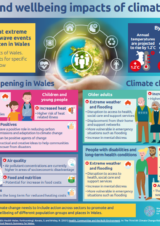
Public Health Wales has published a series of infographics highlighting the importance of climate change impact on the health and wellbeing of the population of Wales, and to support public bodies and businesses to take action to address any impacts.
Launched to coincide with the Council of Parties 26 (COP26), the infographics focus on the relationships between the natural environment and health, the population groups affected and some of the key health and wellbeing impacts of climate change and those population groups who could be affected.
Green Opportunities is a new e-briefing from the Health and Sustainability Hub. The quarterly updates capture learning to aid Wales’ green recovery from COVID-19, identifying sustainable opportunities to support population health.
Adverse childhood experiences (ACEs) are associated with increased health risks across the life course. This paper aims to estimate the annual health and financial burden of ACEs for 28 European countries.
Authors: Karen Hughes, Kat Ford+ 4 more
, Mark Bellis, Freya Glendinning, Emma Harrison, Jonathon Passmore
This briefing is for public health professionals and officials working on public health policy who are interested in how Brexit and trade agreements may affect their work, and for UK and Welsh officials working in trade policy to raise awareness of the relevance of trade to the health and well-being of the people of Wales.
This paper highlights how the combined influences of Brexit, Coronavirus and climate change will potentially impact everyone through the food that is produced, accessed, available and consumed.
Authors: Liz Green, Kathryn Ashton+ 7 more
, Adam Jones, Michael Fletcher, Laura Morgan, Tom Johnson, Tracy Evans, Sumina Azam, Mark Bellis
The International Horizon Scanning and Learning work stream was initiated as a product of, and to inform upon, the evolving COVID-19 public health response and recovery plans in Wales. It focuses on COVID-19 international evidence, experience, measures and transition/recovery approaches, to understand and explore solutions for addressing the on-going and emerging health, wellbeing, social and economic impacts (potential harms and benefits).
Topics of focus are:
– COVID-19 vaccine update
– The impact of COVID-19 on people from the LGBTQ+ community
These reports were used during the period of the Covid 19 pandemic in order to inform the Public Health Wales response and therefore only available in English.
This study, conducted by the Wales Violence Prevention Unit (VPU) and University of Exeter, explores the experiences and behaviours of bystanders to domestic violence and abuse during the COVID-19 pandemic.
Authors: Alex Walker, Rachel A Fenton+ 5 more
, Lara Snowdon, Bryony Parry, Emma Barton, Catherine Donovan, Mark Bellis
Public Health Wales conducted a public engagement telephone survey to ask members of the public in Wales how coronavirus and related control measures are affecting their health and wellbeing. Survey reports aimed to provide data representative of the Welsh population and data are adjusted to represent the Welsh population by age, sex and deprivation.
Public Health Wales has created a practical Health Impact Assessment (HIA) toolkit that will enable planners to easily integrate health into their development plans for the future.
Designed to help further the collaboration between planning and public health sectors in Wales the resource aims to maximise positive health and wellbeing outcomes through land use planning policies that create healthy, equitable and cohesive communities.
Please download Adobe Acrobat Reader before opening this resource in order for full functionality.
This report provides a strategic overview of the impact, and interconnectedness, of the enormous events of Brexit, COVID-19
pandemic and climate change. It identifies the key determinants and population groups affected by the Triple Challenge and provides a key example against a determinant.
Authors: Liz Green, Kathryn Ashton+ 7 more
, Michael Fletcher, Adam Jones, Laura Evans, Tracy Evans, Lee Parry-Williams, Sumina Azam, Mark Bellis
This Summary Calendar has collated, synthesised and presented a clear and concise summary of the COVID-19 International Horizon Scanning Reports over the past year, since April 2020 through to March 2021. The International Horizon Scanning and Learning work stream has proved to showcase informative and impactful research whilst collating data from other countries, providing guidance, recommendations and useful insights regarding the evolving nature and uncertainties of the COVID-19 pandemic.
Authors: Mark Bellis, Mariana Dyakova+ 6 more
, Claire Beynon, Charlotte Bowles, Anna Stielke, James Allen, Abigail Malcolm (née Instone), Lauren Couzens (née Ellis)
To provide the best experiences, we use technologies like cookies to store and/or access device information. Consenting to these technologies will allow us to process data such as browsing behavior or unique IDs on this site. Not consenting or withdrawing consent, may adversely affect certain features and functions.
Functional
Always active
The technical storage or access is strictly necessary for the legitimate purpose of enabling the use of a specific service explicitly requested by the subscriber or user, or for the sole purpose of carrying out the transmission of a communication over an electronic communications network.
Preferences
The technical storage or access is necessary for the legitimate purpose of storing preferences that are not requested by the subscriber or user.
Statistics
The technical storage or access that is used exclusively for statistical purposes.The technical storage or access that is used exclusively for anonymous statistical purposes. Without a subpoena, voluntary compliance on the part of your Internet Service Provider, or additional records from a third party, information stored or retrieved for this purpose alone cannot usually be used to identify you.
Marketing
The technical storage or access is required to create user profiles to send advertising, or to track the user on a website or across several websites for similar marketing purposes.