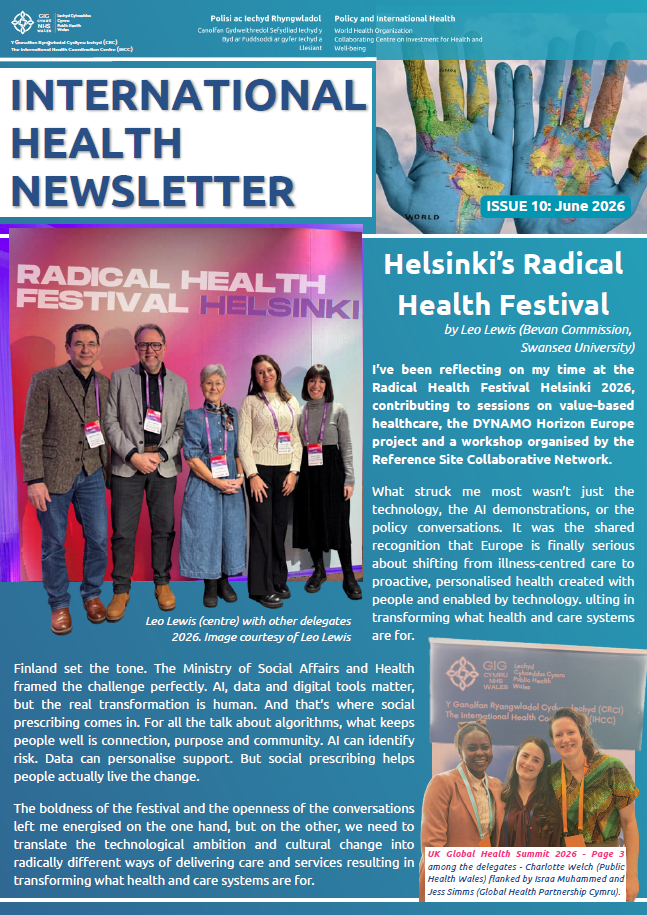
The International Health Coordination Centre’s (IHCC) International Health Newsletter promotes and shares international news, events and initiatives with partners across Wales and beyond.
The newsletter was piloted in May 2023, thereon issued quarterly.
View the latest issue here.
Authors: Laura Holt, Jo Harrington+ 8 more
, Leo Lewis, Jippe Miedema, Henk Hilderink, Keira Charteris, Charlotte Welch, Stanley Ukpai, Mariana Dyakova, Muqaddasa Abdul Wahid
Loneliness and social isolation are increasingly being recognised as public health challenges. This report aims to present loneliness, social isolation and social connection in Wales from a public health perspective. Intended for professionals, policymakers and other individuals working directly or indirectly in the field of social connection, it includes data and evidence on: the prevalence of loneliness, social isolation and social connection in Wales and the population groups most affected; factors that increase the risk of loneliness and social isolation; impacts on health and well-being; evidence on solutions; examples of good practice in Wales; and key areas for future action.
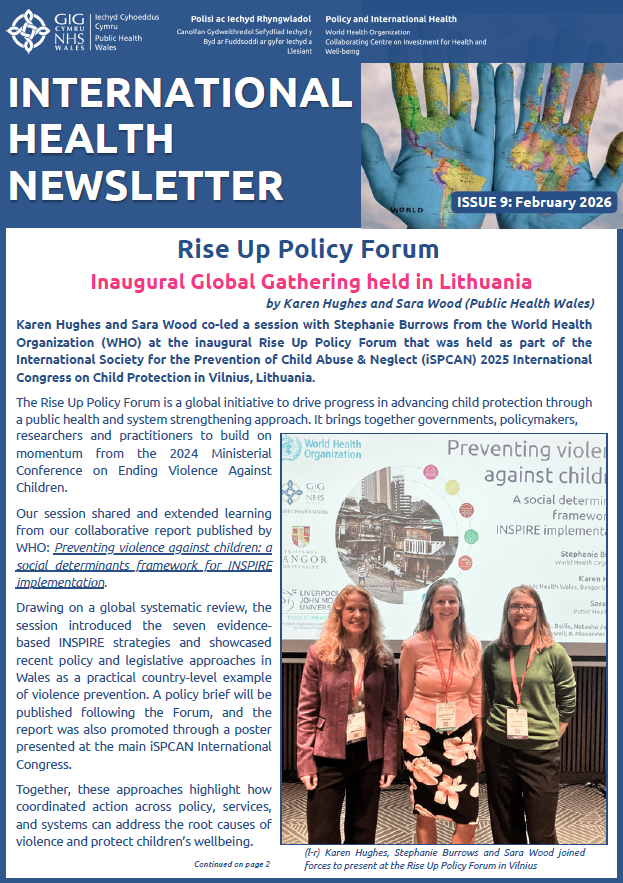
The International Health Coordination Centre’s (IHCC) International Health Newsletter promotes and shares international news, events and initiatives with partners across Wales and beyond.
The newsletter was piloted in May 2023, thereon issued quarterly.
View the latest issue here.
Authors: Laura Holt, Jo Harrington+ 5 more
, Karen Hughes, Sara Wood, Joanne C. Hopkins, Keira Charteris, Liz Green
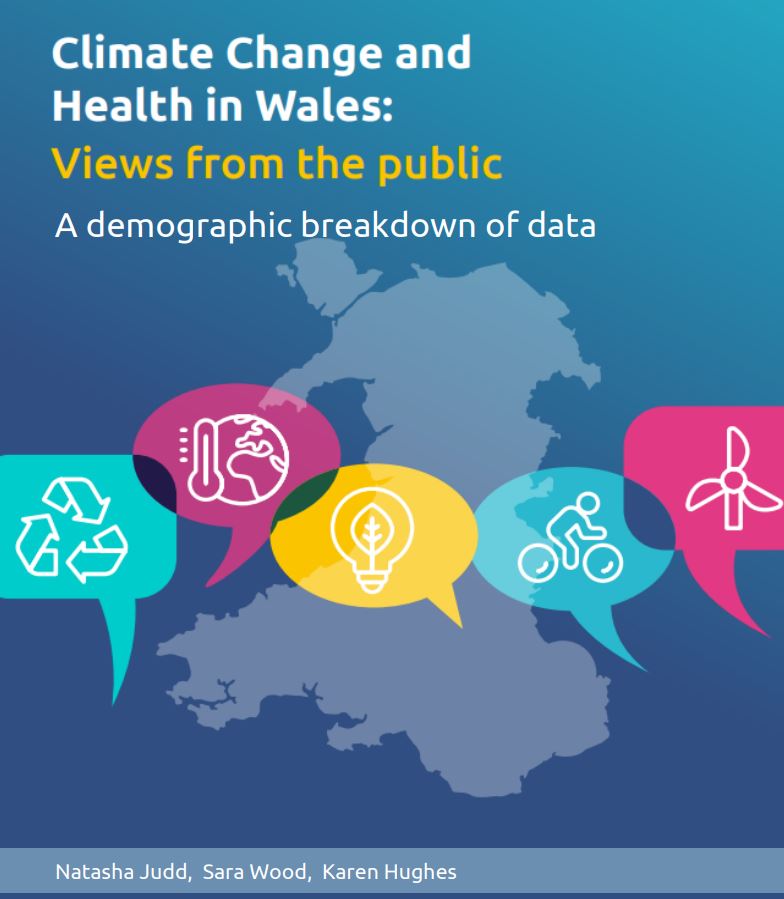
This short report presents a demographic breakdown of data from a national public survey on perceptions of climate change in Wales that was undertaken in 2021/22. The survey explored the population’s views about climate change, its relationship with health, their current climate friendly behaviours, their willingness to engage in action, and views on policy solutions. This report presents data from key survey questions broken down by age group, gender, deprivation quintile, location (rural or urban) and highest qualification. Findings could help tailor awareness campaigns and inform the targeting of key messages and action on climate change in Wales.
This new resource aims to support action on ACEs by providing practical advice on implementing work to prevent ACEs, build resilience, and develop trauma-informed organisations, sectors and systems. It supports the development of a trauma-informed society that is invested in action to prevent ACEs and better support those affected by them.
This report examines the review-level evidence that is available to guide action on reducing socioeconomic inequalities in health. Evidence about public health interventions, programmes and policies applied to populations, groups and other geographically defined areas or jurisdictions was sought to explore whether they preferentially improve the health outcomes of people experiencing socioeconomic inequalities.
This new report brings together what is known about ACEs across Europe and internationally, showing the on-going toxic impact that ACEs can have across the life course and how ACEs and their consequences can be prevented. The report supports the development of a trauma-informed society that is invested in action to prevent ACEs and better support those affected by them.
This report presents initial findings from a survey of adult residents in Wales on their perceptions of climate change and health. Whilst work to understand and mitigate climate change is gaining momentum in Wales, there remains a lack of information on population views and behaviours. Such data are critical for the co-creation of effective and acceptable approaches to climate change that help protect public health; the targeting of key messages and information; and the establishment of long-term solutions across Wales that will continue to be supported across multiple generations. To address this gap, a public survey was developed to seek the population’s views about climate change, its relationship with health, their current climate friendly behaviours, their willingness to engage in action, and views on policy solutions. This report presents initial findings from the survey, providing population-level views on climate change among adult residents in Wales.
Improving understanding of risk factors for risky sexual behaviour is fundamental to achieve better population sexual health. This study explored associations between ACEs and poor sexual health outcomes in the UK. Findings highlight the need for effective interventions to prevent and ameliorate the lifelong effects of ACEs. Trauma-informed relationships and sex education, sexual health services, and antenatal/postnatal services, particularly for teenagers and young parents, could provide opportunities to prevent ACEs and support those affected.
Authors: Sara Wood, Kat Ford+ 4 more
, Hannah Madden, Catherine Sharp, Karen Hughes, Mark Bellis
Childhood adversity has been shown to be linked to poorer mental well-being, with some studies suggesting it may lead to reduced trust in health and other public services. Research conducted with adults in Wales identified that vaccine hesitancy was three times higher among people who had experienced four or more types of childhood trauma than it was among those who hadn’t experienced any.
Authors: Mark Bellis, Karen Hughes+ 4 more
, Kat Ford, Hannah Madden, Freya Glendinning, Sara Wood
This review aimed to synthesise research examining the impact of behavioural risk factors commonly associated with non-communicable diseases on risks of contracting, or having more severe outcomes from, communicable diseases.
Authors: Sara Wood, Sophie Harrison+ 4 more
, Natasha Judd, Mark Bellis, Karen Hughes, Andrew Jones
Public Health Wales conducted a public engagement telephone survey to ask members of the public in Wales how coronavirus and related control measures are affecting their health and wellbeing. Survey reports aimed to provide data representative of the Welsh population and data are adjusted to represent the Welsh population by age, sex and deprivation.
Public Health Wales conducted a public engagement telephone survey to ask members of the public in Wales how coronavirus and related control measures are affecting their health and wellbeing. Survey reports aimed to provide data representative of the Welsh population and data are adjusted to represent the Welsh population by age, sex and deprivation.
Public Health Wales conducted a public engagement telephone survey to ask members of the public in Wales how coronavirus and related control measures are affecting their health and wellbeing. Survey reports aimed to provide data representative of the Welsh population and data are adjusted to represent the Welsh population by age, sex and deprivation.
To support the work of partner agencies in re-opening nightlife safely following the first COVID-19 lockdown, the Wales Violence Prevention Unit conducted rapid research to assess the evidence and emerging global best practice for re-opening nightlife whilst containing COVID-19 and preventing violence. The report includes key examples of how nightlife has re-opened across the world, how measures to reduce risks of COVID-19 may impact on risks of violence, and provides key considerations for opening up nightlife in Wales.
Authors: Hayley Janssen, Katie Cresswell+ 7 more
, Natasha Judd, Karen Hughes, Lara Snowdon, Emma Barton, Daniel Jones, Sara Wood, Mark Bellis
This report aims to bring together what we know about ACEs in refugee and asylum seeking children arriving and settling into host countries, highlighting their nature, extent and impact.
Authors: Sara Wood, Kat Ford+ 4 more
, Katie Hardcastle, Jo Hopkins, Karen Hughes, Mark Bellis
This report aims to describe the impact of winter and cold weather on health and well-being in Wales and the subsequent effects on health and care services, in a way that can inform strategic planning for the future.
Authors: Sumina Azam, Thomas Jones+ 4 more
, Sara Wood, Emily Bebbington, Louise Woodfine, Mark Bellis
This technical report acknowledges the effects of traditional seasonal factors that cause poor health such as influenza and injuries due to falls, as well as finding wider issues such as poverty, poor housing and unhealthy behaviours having a significant impact on winter health and well-being.
Authors: Sumina Azam, Thomas Jones+ 4 more
, Sara Wood, Emily Bebbington, Louise Woodfine, Mark Bellis
A study to examine if data routinely collected by child death overview panels (CDOPs) could be used to measure ACE exposure and examine any associations between ACEs and child death categories. Data covering four years (2012-2016) of cases from a CDOP in North West England were studied.
Gambling is increasingly being recognised as a public health priority. Recent years have seen a rapid growth in the availability and advertising of gambling, driven by factors including relaxed gambling regulations and technological development.
Authors: Robert D. Rogers, Heather Wardle+ 6 more
, Catherine Sharp, Sara Wood, Karen Hughes, Timothy J. Davies, Simon Dymond, Mark Bellis
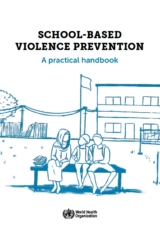
This resource: School-based violence prevention: a practical handbook, is about schools, education and violence prevention. It provides guidance for school officials and education authorities on how schools can embed violence prevention within their routine activities and across the points of interaction schools provide with children, parents and other community members. If implemented, the handbook will contribute much to helping achieve the SDGs and other global health and development goals.
A study to examine if, and to what extent, a history of adverse childhood experiences (ACEs) combines with adult alcohol consumption to predict recent violence perpetration and victimisation.
Authors: Mark Bellis, Karen Hughes+ 5 more
, Kat Ford, Sara Edwards, Olivia Sharples, Katie Hardcastle, Sara Wood
Adverse childhood experiences (ACEs) including maltreatment and exposure to household stressors can impact the health of children. Community factors that provide support, friendship and opportunities for development may build children’s resilience and protect them against some harmful impacts of ACEs. This paper examines if a history of ACEs is associated with poor childhood health and school attendance and the extent to which such outcomes are counteracted by community resilience assets.
Authors: Mark Bellis, Karen Hughes+ 6 more
, Kat Ford, Katie Hardcastle, Catherine Sharp, Sara Wood, Lucia Homolova, Alisha Davies
To provide the best experiences, we use technologies like cookies to store and/or access device information. Consenting to these technologies will allow us to process data such as browsing behavior or unique IDs on this site. Not consenting or withdrawing consent, may adversely affect certain features and functions.
Functional Always active
The technical storage or access is strictly necessary for the legitimate purpose of enabling the use of a specific service explicitly requested by the subscriber or user, or for the sole purpose of carrying out the transmission of a communication over an electronic communications network.
Preferences
The technical storage or access is necessary for the legitimate purpose of storing preferences that are not requested by the subscriber or user.
Statistics
The technical storage or access that is used exclusively for statistical purposes.The technical storage or access that is used exclusively for anonymous statistical purposes. Without a subpoena, voluntary compliance on the part of your Internet Service Provider, or additional records from a third party, information stored or retrieved for this purpose alone cannot usually be used to identify you.
Marketing
The technical storage or access is required to create user profiles to send advertising, or to track the user on a website or across several websites for similar marketing purposes.