This report is for the staff, teams and services in Public Health Wales, and the wider public health system in Wales. It sets out the range of work which the BSU has undertaken over the last year, with a spotlight on some of our key activities. It acknowledges the partners who have worked with us, provides insight for those that are considering working with us and, reflects on our impact as well as delivery.
The key findings from this report highlight the need for comprehensive and multi-faceted policy approaches to address health inequalities. The evidence highlights the importance of preserving equitable healthcare access, expanding the welfare state, and targeting health-related behaviours through coordinated intersectoral strategies. By learning from international examples and adapting successful policies, Wales can work towards effective actions to reducing health inequalities and improving overall population health and wellbeing.
Authors: Lisa Jones, Mennatallah Abdelgawad+ 1 more
This interactive workbook builds on the ‘SCALE’ framework, first introduced by the Behavioural Science Unit in 2023. The workbook includes a number of activities, designed to help guide you through the process of developing a piece of communication using behavioural science.
The Behaviourally Informed Communications Initiative (BICI) first launched in 2024, with 30+ attendees from a range of different teams bringing a piece of communication to optimise using behavioural science. This collection of case studies helps to outline the real-world application of BICI – including work from screening teams, vaccination teams, as well as Greener Primary Care and Primary Care.
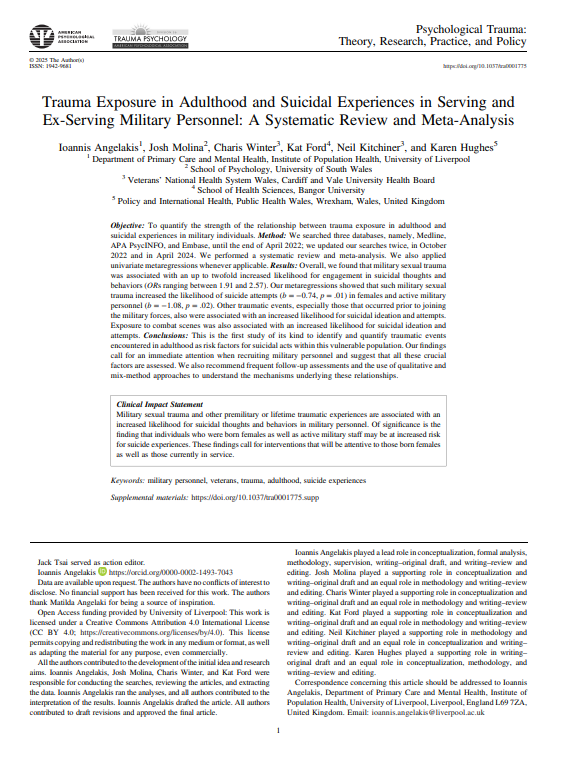
Research has consistently shown a higher prevalence of mental health challenges and suicidal ideation and attempts among active-duty military personnel and veterans compared to the general population. Traumatic experiences in adulthood, particularly those encountered during military deployment, can significantly increase the risk of suicidal ideation and attempts. This systematic review and meta-analysis aimed to examine the relationship between trauma exposure in adulthood and suicidal experiences within military populations.
The findings indicate that both pre-service traumatic events and those experienced during employment are linked to a higher likelihood of suicidal ideation and attempts. The study underscores the critical need for targeted interventions to address trauma in military personnel.
Authors: Ioannis Angelakis, Josh Molina+ 4 more
, Charis Winter, Kat Ford, Neil Kitchiner, Karen Hughes
The Behaviourally Informed Communications Initiative launched in June 2024, with over 35 stakeholders from a range of different teams brining a piece of communication to optimise by applying behavioural science. This report includes information about how the initative was developed and delivered, including process evaluation insight from cohort attendees and two case studies.
Long-term thinking is key to ensuring a healthier, more sustainable Wales for current and future generations. We are facing challenging times in Wales, with our healthcare services, wider public sector, and third sector under unprecedented strain. This makes it more important than ever, but also harder than ever, to balance managing the crises of today with preventing the crises of the future. We need to know what’s on the horizon in order to minimise surprises and make better decisions.
This is exactly what our new Horizon Scanning toolkit, developed in collaboration with the Office of the Future Generations Commissioner, aims to support.
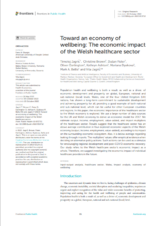
In this paper, the economic importance of the healthcare sector to the Welsh economy is explored. We use a large number of data sources for the UK and Welsh economy to derive an economic model for 2017. This economic modelling aims to quantify the contribution of the healthcare sector (the National Health Service, NHS) to the wider economy in Wales, looking at the economic output, population income, value added imports, and employment. Results suggest that the healthcare sector has an above average contribution in four explored economic aspects of the Welsh economy (output, income, employment, value-added), according to its impact on the surrounding economic ecosystem. A summary of the report has been developed to support and inform national and international stakeholders across various sectors, including economics, finance, health, and policy. It is particularly useful for those working in relation to the Foundational Economy, Social Value and Wellbeing Impacts and Value-Based Health.
Authors: Timotej Jagrič, Christine Brown+ 6 more
, Dušan Fister, Oliver Darlington, Kathryn Ashton, Mariana Dyakova, Mark Bellis, Vita Jagrič
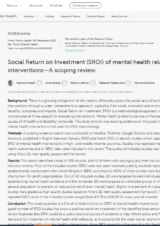
Social Return on Investment (SROI) is a methodological approach which incorporates all three aspects for evaluating interventions. Mental health problems are one of the leading causes of ill health and disability worldwide. This study aims to map existing evidence on the social value of mental health interventions that uses the SROI methodology. This scoping review is a first of its kind to focus on SROI of mental health interventions, finding a good number of SROI studies that show a positive return on investment of the identified interventions. An evidence brief has been produced outlining the key findings of the scoping review. The evidence brief highlights the social value of mental health interventions in high- and middle-income countries and outlines individual examples.
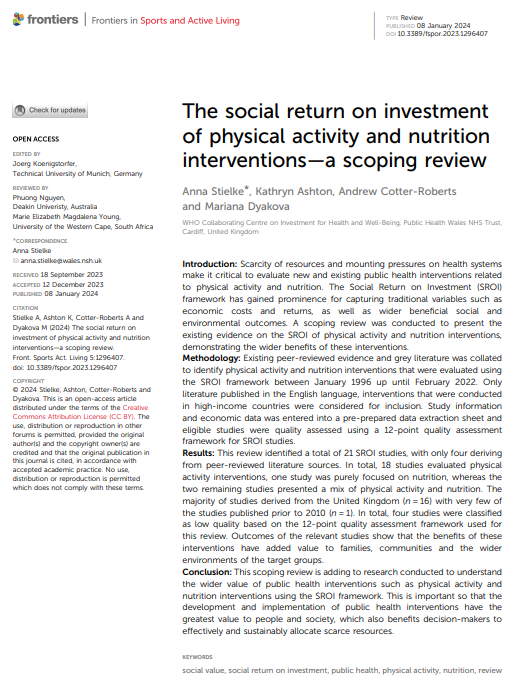
Scarcity of resources for public health and mounting pressures on health systems such as the Covid-19 pandemic, make it vital to evaluate public health interventions and move away from traditional evaluation methods. This is important to understand not just the financial value of public health interventions, but also the wider social, environmental and economic value. This review aims to present the existing evidence base on the Social Return on Investment of physical activity and nutrition interventions, demonstrating the wider social and environmental benefits of these interventions.
It becomes increasingly important that the holistic impact of nutrition and physical activity interventions and programmes is understood to enable the development and implementation of interventions which have the greatest value to people. An evidence brief has been produced outlining the key findings of the scoping review and provides individual examples of the social value of interventions identified which aimed to increase levels of physical activity and improve nutrition.
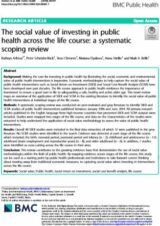
This review maps an overview of the application of Social Return on Investment (SROI) and Social Cost-Benefit Analysis (SCBA) in existing literature to identify the social value of public health interventions at individual stages of the life course. The importance of capturing social value is highlighted and the results indicate the positive value of investing in public health interventions. This evidence can be used as a starting point by public health professionals and institutions that are looking beyond traditional economic measures, and towards capturing social value when investing in interventions across the life course. An evidence brief has been produced outlining the key findings of the scoping review and provides individual examples of the social value of interventions at individual stages of the life course identified in the scoping review.
Authors: Kathryn Ashton, Peter Schröder-Bäck+ 4 more
, Timo Clemens, Mariana Dyakova, Anna Stielke, Mark Bellis
This report highlights key themes to progress including relationship-building, capability development, and the practical application of behavioural science in policy and practice. As a crucial approach to improving health outcomes and reducing inequalities, behavioural science can help optimise policy, services and communications to support delivery of the Public Health Wales Long Term Strategy. This realist ripple effects evaluation provides key recommendations to drive continued impact.
Time to Talk Public Health is a nationally representative panel of Welsh residents established by Public Health Wales to enable regular public engagement to inform public health policy and practice. The panel is designed to be broadly representative of the Welsh population by age, sex, deprivation, ethnicity and health board. This report presents findings from the November 2024 survey covering: Healthy Life Expectancy, Awareness of health services, Vaccines, and a Violence prevention approach called Stop and Search.
The report explores trauma-informed training availability and needs of English for Speakers of Other Languages (ESOL) practitioners in Wales. ESOL learners come from diverse backgrounds, including refugees and asylum seekers who may have experienced complex trauma. It is essential that ESOL providers are trained to provide valuable support to these learners. The report presents findings from interviews with ESOL practitioners across Wales, exploring their training experiences and identifying additional training needs. The report’s recommendations focus on enhancing trauma-informed training availability and delivery in Wales. The report is designed for ESOL practitioners and policymakers interested in trauma-informed approaches to teaching.
The second issue of the Bitesize BeSci e-bulletin features case studies and resources that look at the benefits of interdisciplinary and collaborative working when applying behaviour change interventions.
This study examined relationships between adverse childhood experiences (ACEs), school experiences and adult health outcomes in a sample of the Welsh adult general population. It found ACEs and negative school experiences (having been bullied and lower sense of school belonging) were independently associated with poorer adult mental health. Experiencing both ACEs and negative school experiences exacerbated risks of poorer mental health. The study indicates the protective role that schools may play in fostering resilience among children who experience adversity in home settings.
Authors: Karen Hughes, Mark Bellis+ 5 more
, Kat Ford, Catherine Sharp, Joanne C. Hopkins, Rebecca Hill, Katie Cresswell
This paper presents secondary data analysis from Time to Talk Public Health.
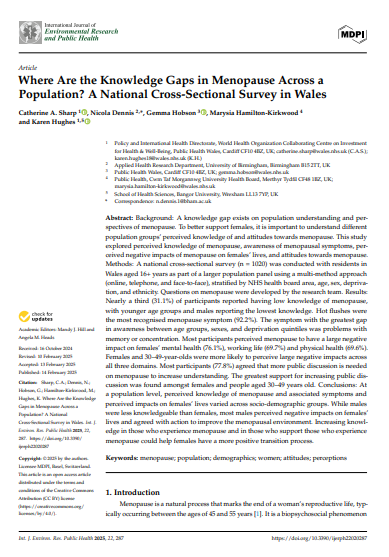
This study explored perceived knowledge of menopause, awareness of menopausal symptoms, perceived negative impacts of menopause on females’ lives, and attitudes towards menopause. Most participants reported having low knowledge of the menopause, but were aware of ‘stereotypical’ symptoms such as hot flushes and changes to mood. This study highlights differences in knowledge and attitudes to menopause by different socio-demographics (e.g. age, gender). More evidence and understanding is needed on menopause, from both those who experience the menopause and those who do not experience the menopause, to support woman to have a more positive experience.
This Spotlight Feature looks at examples of the Inverse Care Law in Wales, alongside strategies and initiatives across Wales which aim to reduce inequalities through General Practice and place-based partnerships.
The International Horizon Scanning and Learning reports were initiated as part of the COVID-19 public health response, to support dynamic response and recovery measures and planning in Wales. In spring 2022, the scope of the reports was expanded to cover priority public health topics, including in the areas of health improvement and promotion, health protection, and health care public health.
In focus: Fiscal Levers to Address Obesity.
Authors: Keira Charteris, Ilona Johnson+ 8 more
, Mariana Dyakova, Zuwaira Hashim, Morgan Savoury, Anna Howells, Josh Levett, Leonor Gonzalez de Mendoza Cremades, Sumina Azam, Emily Finney
Good health is a fundamental right, but in Wales, health outcomes vary unfairly across communities. This report emphasises the importance of investing in prevention to help everyone live longer, healthier lives. Effective prevention programmes offer great value for money and essential for prioritising public funding. They can address health inequalities, reverse the nation’s health decline, and promote well-being.
The report integrates previous findings with recent research on value-for-money public health programmes, highlighting successful interventions across three life stages: early years, healthy adults, and healthy ageing. It highlights that prevention must be part of a broader strategy to reduce health inequalities, focusing on early years and poverty reduction, with targeted spending in Wales’ most deprived communities.
Authors: Rebecca Masters, Ann Jones+ 6 more
, Anna Stielke, Rajendra Kadel, Sumina Azam, Jo Davies, Leah Jenkins, Aseel Dardur
The International Health Coordination Centre’s (IHCC) International Health Newsletter promotes and shares international news, events and initiatives with partners across Wales and beyond.
The newsletter was piloted in May 2023, thereon issued quarterly.
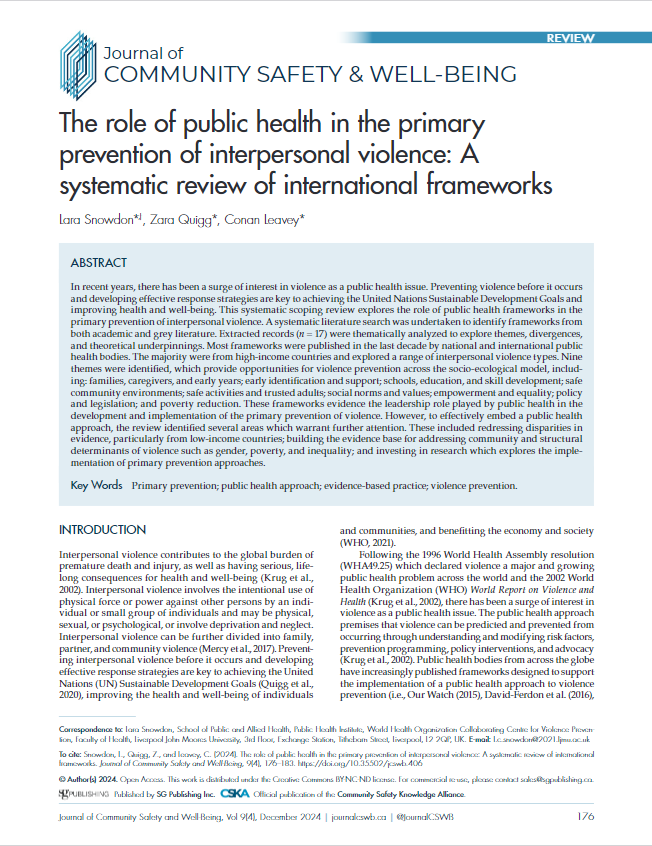
In recent years, there has been a surge of interest in violence as a public health issue. Preventing violence before it occurs and developing effective response strategies are key to achieving the United Nations Sustainable Development Goals and improving health and well-being. This systematic scoping review explores the role of public health frameworks in the primary prevention of interpersonal violence.
An evaluation conducted in Cardiff and Swansea, explores the Wales Violence Prevention Unit’s (VPU) whole-system approach to violence prevention, which provides key learning and considerations for the development of local violence prevention partnerships.
Conducted by the Public Health Institute, Liverpool John Moore’s University, the evaluation provides important learning on how to implement violence prevention activity on a local level to suit local needs whilst also building structures that enable this work to influence the wider system.
The evaluation consists of two parts, with one evaluation focusing on the whole-systems approach in Swansea, and one in Cardiff, totaling four full reports. To support partners in drawing from these evaluations, the VPU has condensed the key findings and recommendations into one summary report.
Authors: Ellie McCoy, Chloe Smith+ 5 more
, Rebecca Harrison, Alice Booth-Rosamond, Hannah Timpson, Zara Quigg, Alex Walker
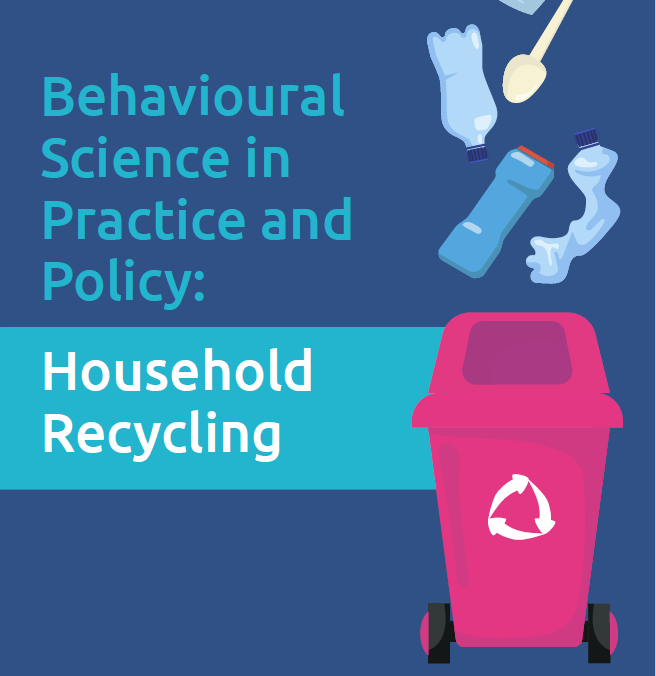
In order to effectively change climate-related behaviours, we must be clear and specific about the behaviour that we’re hoping to change, understand the barrier(s) and/or faciliator(s) to the target behaviour, and implement a broad range of interventions to address and/or enhance the identified barrier(s) and/or facilitator(s). Using household recycling as an example, the purpose of this case study is to show how applying behavioural science can help to identify and implement a range of different intervention types that can help to effectively address behavioural determinants and influence behaviour.
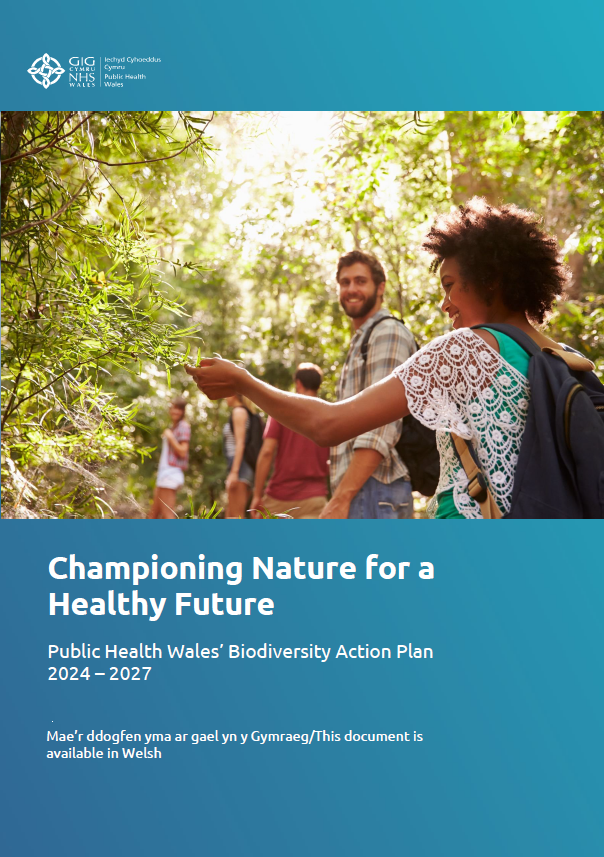
The report sets out how Public Health Wales is taking action to maintain and enhance biodiversity and promote the resilience of ecosystems. As part of the Environment (Wales) Act 2016, section 6, we have a duty to publish a plan and report on our progress. Our work to support biodiversity contributes to the well-being goal of a ‘resilient Wales’ as well as our other strategic priorities. Whilst the plan is focused on what Public Health Wales will do, it also recognises the need to work in partnership across the wider public health system in Wales and with colleagues in other sectors.
The report covers:
• The importance of biodiversity to health and wellbeing and the challenges presented by the current nature crisis
• A summary of what has been achieved since the last Biodiversity Action Plan was published in 2019
• An outline of how the new plan has been developed
• The actions planned for the next 3 years and how we will report our progress
Time to Talk Public Health is a nationally representative panel of Welsh residents established by Public Health Wales to enable regular public engagement to inform public health policy and practice. The panel is designed to be broadly representative of the Welsh population by age, sex, deprivation, ethnicity and health board. This report presents findings from the August 2024 survey covering: Cardiovascular health, Non-Emergency Patient Transport Service, travelling to health appointments, healthy weight, mealtimes and vaccines.
This series includes practical resources to help support you when applying behavioural science to your work. Inside, you’ll find a range of case studies, resources, tools and guides to help put behavioural science theory into practice and optimise the outcomes of your work.
‘The Country deep dive on the well-being economy: Wales’ is part of a series of country deep dives published under the WHO European Well-being Economy Initiative led by the WHO European Office for Investment and Development. Each publication in the series is developed by combining academic and grey literature with narratives from semi structured interviews conducted with key stakeholders in government and public health institutions, with the aim to demonstrate concrete country experiences in advancing and implementing well-being economies.
This deep dive focuses on the Welsh approach. It gives context for Wales’s commitment to the well-being economy agenda, and identifies key concepts and strategies, governance structures and mechanisms, the role of (public) health, and approaches to measuring and monitoring progress. It highlights both the drivers and barriers Wales has encountered on the path towards a well-being economy. While Wales’s experience is not representative or all-encompassing, countries that are considering or in the process of shifting to a well-being economy can look at these key findings and take-home policy messages for inspiration.
This publication focuses on the use of Health Impact Assessment (HIA) by public bodies in Wales as a process that can support policymakers and those involved in decision taking to maximise well-being benefits, minimise harm to health, and avoid widening health inequalities. It also supports public bodies in meeting duties under the Public Health (Wales) Act (2017).
To provide the best experiences, we use technologies like cookies to store and/or access device information. Consenting to these technologies will allow us to process data such as browsing behavior or unique IDs on this site. Not consenting or withdrawing consent, may adversely affect certain features and functions.
Functional
Always active
The technical storage or access is strictly necessary for the legitimate purpose of enabling the use of a specific service explicitly requested by the subscriber or user, or for the sole purpose of carrying out the transmission of a communication over an electronic communications network.
Preferences
The technical storage or access is necessary for the legitimate purpose of storing preferences that are not requested by the subscriber or user.
Statistics
The technical storage or access that is used exclusively for statistical purposes.The technical storage or access that is used exclusively for anonymous statistical purposes. Without a subpoena, voluntary compliance on the part of your Internet Service Provider, or additional records from a third party, information stored or retrieved for this purpose alone cannot usually be used to identify you.
Marketing
The technical storage or access is required to create user profiles to send advertising, or to track the user on a website or across several websites for similar marketing purposes.