The seventh issue of the Bitesize BeSci e-bulletin features advice, case studies and resources on the ‘appliance of science’ – practical examples and tips to help you implement behavioural science within your own work!
This impact report is for Public Health Wales staff, and stakeholders working across the wider public health system in Wales. It sets out the range of work which the Behavioural Science Unit has undertaken over 2025-2026, focusing on how the Unit is progressing against the areas outlined in the Behavioural Science Enabling Plan for Wales. It acknowledges the partners who have worked with the Unit, provides insight for those that are considering future collaboration, and reflects on the contribution of collective activities towards the routine application of behavioural science for better health and equity.
Authors: Jason Roberts, Jennifer Thomas+ 8 more
, Jonathan West, Ashley Gould, Nicky Knowles, Alice Cline, Melda Lois Griffiths, Paulina Kuczynska, Khudayja Datoo-Jaffer, James Smolinski
This plan describes a route map of important actions that can secure the conditions to enable the more routine and systematic use of behavioural science in services, improvement and innovation, communications, policy and systems approaches that that are aiming for better health and wellbeing.
Developed with a technical and strategic advisory group, and input from our Behavioural Science Community for Wales, the plan draws on regional and international approaches to behavioural science application in health and wellbeing, and describes how, through applying behavioural science in our work, we can get what we aim for more often, and in doing so realise a behavioural dividend that optimises our impact for better health and equity.
This spotlight feature blog explores the critical challenge of designing health interventions. It introduces key behavioural science concepts and showcases how the BSU is supporting the application of them, along with reference to a suite of resources to support more equitable public health action.
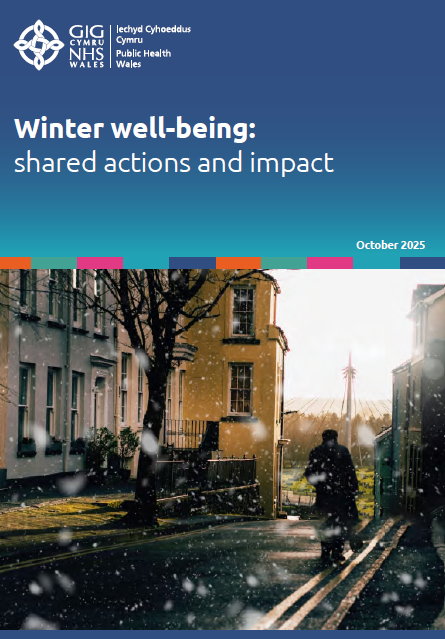
A new report by Public Health Wales brings together the latest evidence, behavioural insights and practical tools to support health and care colleagues and services in preparing for the winter months.
The report, Winter Well-being: Shared Actions and Impact, is designed to complement existing NHS and Welsh Government winter planning frameworks. It provides actionable guidance and checklists to help teams strengthen system resilience, maintain population health, and ease demand on services.
The report also highlights the importance of prevention, including protecting against winter viruses by getting vaccinated against flu, RSV and COVID-19, staying active, eating warm meals, checking in on neighbours, and taking vitamin D daily to stay healthy through the colder months.
Authors: Ashley Gould, Kat Ford+ 7 more
, Elizabeth Augarde, Karen Hughes, Natasha Judd, Alice Cline, Molly Bellis, Carys Dale, Sumina Azam
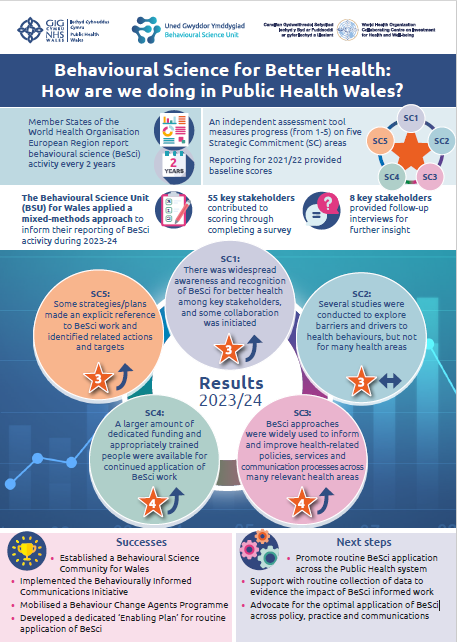
An Infographic summarising the evaluation and reporting of our progress across five World Health Organisation ‘Strategic Commitment’ areas, for working towards the routine application of behavioural science for better health in Wales.
This report is for the staff, teams and services in Public Health Wales, and the wider public health system in Wales. It sets out the range of work which the BSU has undertaken over the last year, with a spotlight on some of our key activities. It acknowledges the partners who have worked with us, provides insight for those that are considering working with us and, reflects on our impact as well as delivery.
This interactive workbook builds on the ‘SCALE’ framework, first introduced by the Behavioural Science Unit in 2023. The workbook includes a number of activities, designed to help guide you through the process of developing a piece of communication using behavioural science.
The Behaviourally Informed Communications Initiative (BICI) first launched in 2024, with 30+ attendees from a range of different teams bringing a piece of communication to optimise using behavioural science. This collection of case studies helps to outline the real-world application of BICI – including work from screening teams, vaccination teams, as well as Greener Primary Care and Primary Care.
The Behaviourally Informed Communications Initiative launched in June 2024, with over 35 stakeholders from a range of different teams brining a piece of communication to optimise by applying behavioural science. This report includes information about how the initative was developed and delivered, including process evaluation insight from cohort attendees and two case studies.
This report highlights key themes to progress including relationship-building, capability development, and the practical application of behavioural science in policy and practice. As a crucial approach to improving health outcomes and reducing inequalities, behavioural science can help optimise policy, services and communications to support delivery of the Public Health Wales Long Term Strategy. This realist ripple effects evaluation provides key recommendations to drive continued impact.
The second issue of the Bitesize BeSci e-bulletin features case studies and resources that look at the benefits of interdisciplinary and collaborative working when applying behaviour change interventions.
This series includes practical resources to help support you when applying behavioural science to your work. Inside, you’ll find a range of case studies, resources, tools and guides to help put behavioural science theory into practice and optimise the outcomes of your work.
Written in collaboration with the Central Evaluation Team and Public Health Wales, this is a practical and interactive tool that identifies key points to take into consideration when you’re planning how to test and evaluate your behaviour change intervention.
Authors: Alice Cline, Nicky Knowles+ 5 more
, Jonathan West, Lucia Homolova, Dr Charlotte Grey, Dr Esther Mugweni, Ashley Gould
A practical, interactive tool that introduces Behaviour Change Techniques, considered to be the ‘active ingredients’ of behaviour change interventions. The tool walks you through how to identify and deliver Behaviour Change Techniques, drawing on the COM-B model and Behaviour Change Wheel.
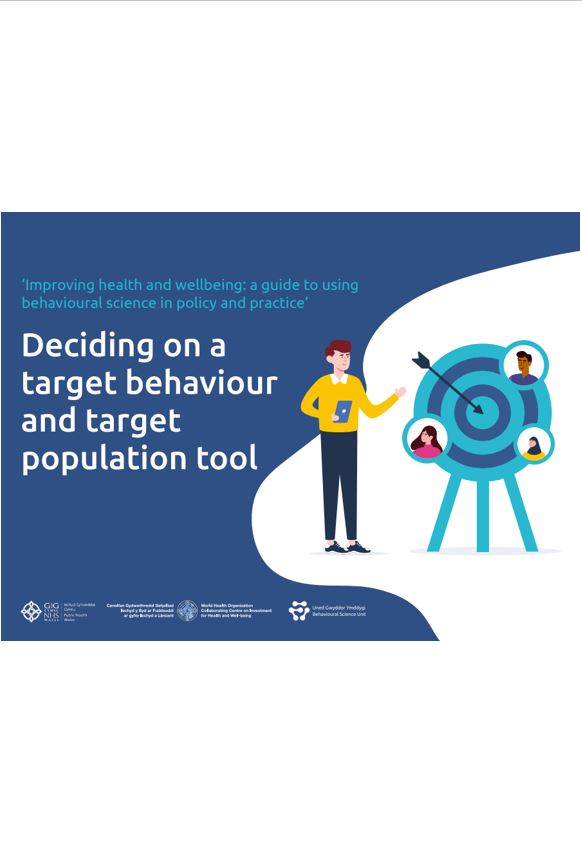
A practical, interactive tool to help you consider and define your target behaviour and target population, as you create a ‘behavioural specification’.
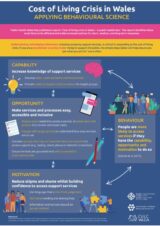
Understanding and shaping behaviours, including accessing support services, is critical in responding to the cost of living crisis. This infographic illustrates how behavioural science can be used, drawing on the report written by Public Health Wales and the resources produced by Hertfordshire County Council’s Behavioural Science Unit.
The climate crisis presents a persistent and growing environmental burden of disease with significant public health consequences. Addressing the crisis via mitigation and adaptation methods requires changing our behaviour. This guide is for professionals/practitioners working on policy, services or communications to tackle the climate crisis, offering useful tips on incorporating behavioural insights and increasing the likelihood of a change in behaviour being adopted.
This guide for practitioners and policy makers provides a brief introduction to behavioural science and a step-by-step process for developing behaviour change interventions – whether policy, service or communications. It’s designed to support topic-matter experts to optimise their interventions – helping to ensure we more often ‘get what we aim for’. Improving health and wellbeing: a guide to using behavioural science in policy and practice
To provide the best experiences, we use technologies like cookies to store and/or access device information. Consenting to these technologies will allow us to process data such as browsing behavior or unique IDs on this site. Not consenting or withdrawing consent, may adversely affect certain features and functions.
Functional Always active
The technical storage or access is strictly necessary for the legitimate purpose of enabling the use of a specific service explicitly requested by the subscriber or user, or for the sole purpose of carrying out the transmission of a communication over an electronic communications network.
Preferences
The technical storage or access is necessary for the legitimate purpose of storing preferences that are not requested by the subscriber or user.
Statistics
The technical storage or access that is used exclusively for statistical purposes.The technical storage or access that is used exclusively for anonymous statistical purposes. Without a subpoena, voluntary compliance on the part of your Internet Service Provider, or additional records from a third party, information stored or retrieved for this purpose alone cannot usually be used to identify you.
Marketing
The technical storage or access is required to create user profiles to send advertising, or to track the user on a website or across several websites for similar marketing purposes.