The International Horizon Scanning and Learning reports were initiated as part of the COVID-19 public health response, to support dynamic response and recovery measures and planning in Wales. In spring 2022, the scope of the reports was expanded to cover priority public health topics, including in the areas of health improvement and promotion, health protection, and health care public health.
In focus: Mental Health and Well-being of Refugees and Asylum-Seekers
Authors: Leah Wargent, Daniela Stewart+ 3 more
, Lauren Couzens (née Ellis), Sara Cooklin-Urbano, Mariana Dyakova
The Welsh Health Equity Solutions Platform will act as a repository of information, case studies, and previous interventions used to help combat inequity and share good practice in Wales. The platform features searchable data tools and a report-generating function which allows users to input their search terms and produce outputs related to those terms. The platform also offers a spotlight feature that can be used to highlight particular solutions or themes. The team will develop the platform over time to add additional content and features.
Authors: Rebecca Hill, Jo Peden+ 12 more
, Lauren Couzens (née Ellis), Mariana Dyakova, Daniela Stewart, James Allen, Liz Green, Rebecca Masters, Leah Wargent, Sara Cooklin-Urbano, Golibe Ezenwugo, Abigail Malcolm (née Instone), Jason Roberts, Rajendra Kadel
The International Horizon Scanning and Learning reports were initiated as part of the COVID-19 public health response, to support dynamic response and recovery measures and planning in Wales. In spring 2022, the scope of the reports was expanded to cover priority public health topics, including in the areas of health improvement and promotion, health protection, and health care public health.
In focus: Universal primary Free School Meals
Authors: Leah Silva, Abigail Malcolm+ 4 more
, Lauren Couzens, Sara Cooklin Urbano, Emily Clark, Mariana Dyakova
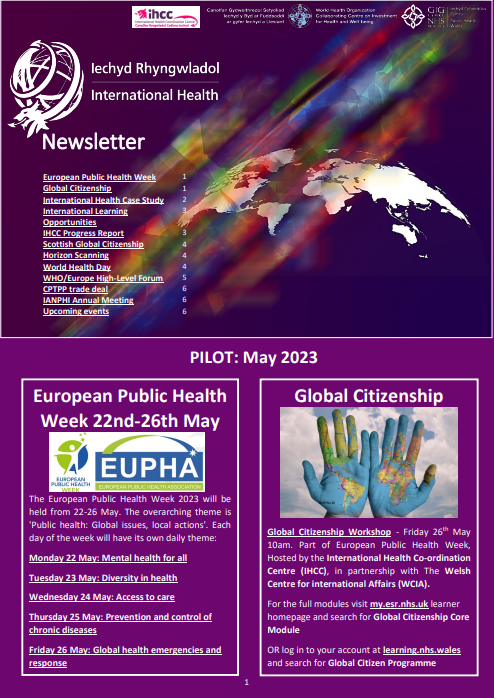
The International Health Coordination Centre’s (IHCC) International Health Newsletter promotes and shares international news, events and initiatives with partners across Wales and beyond.
The newsletter was piloted in May 2023, thereon issued quarterly.
This International Horizon Scanning and Learning Summary Calendar is the third in the series, following the Summary Calendars from 2020/21 and 2021/22. This Summary Calendar has collated, synthesised, and presented a clear and concise synopsis of the five International Horizon Scanning Reports over the past year, since April 2022 through to March 2023. In addition, the two summary reports (published in 2022) are included. The International Horizon Scanning and Learning work stream has proved to showcase informative and impactful research whilst collating data from other countries and has provided guidance, recommendations, and useful insights regarding the evolving nature and uncertainties of emerging public health topics, which has sought to improve and inform such actions and approaches in Wales.
The summary aims to inform a succinct overview of comprehensive, coherent, inclusive and evidence-informed policy action, which has supported and continues to support the national strategies towards a healthier, more equal, resilient, prosperous and globally responsible Wales. This calendar includes key messages and key recommendations from the high level synthesis pages of each International Horizon Scanning report.
Themes include: • Intermediate care • The cost of living crisis • COVID-proofing the educational environment: 4-18 years • Early childhood education and care • Communication campaigns for vaccine acceptance • The impact of COVID-19 on mental health and increasing vulnerability • The impact of COVID-19 on increasing the health gap and vulnerability
Authors: Mariana Dyakova, Emily Clark+ 14 more
, Andrew Cotter-Roberts, Abigail Malcolm (née Instone), Golibe Ezenwugo, Leah Wargent, Anna Stielke, Sara Cooklin-Urbano, Lauren Couzens (née Ellis), James Allen, Aimee Challenger, Claire Beynon, Mark Bellis, Mischa Van Eimeren, Angie Kirby, Benjamin Bainham
This report outlines the International Health Coordination Centre’s (IHCC) progress in driving and enabling implementation of the Charter for International Health Partnerships in Wales (the Charter) across the NHS over the last four years. It also provides examples of international health partnership working from across the Health Boards and NHS Trusts. The report highlights the IHCC’s plans and aspirations for the future, in supporting a healthier, more equal, globally responsible, resilient and prosperous NHS in Wales.
The report highlights the IHCC’s role, achievements, ways of working, collaborative structures and activities; and outlines the evolution of the IHCC in relation to global, UK, national and local developments. These include challenges and opportunities such as the UK withdrawal from the European Union (‘Brexit’), the COVID-19 pandemic and the ‘cost of living’ crisis. It demonstrates the tools used to enable shared learning, facilitate cross-NHS and cross-sector synergies, and maximise benefits to the health and well-being of the people in Wales and beyond.
The International Horizon Scanning and Learning reports were initiated as part of the COVID-19 public health response, to support dynamic response and recovery measures and planning in Wales. In spring 2022, the scope of the reports was expanded to cover priority public health topics, including in the areas of health improvement and promotion, health protection, and health care public health.
In focus: Communication campaigns for vaccine acceptance
Authors: Abigail Malcolm (née Instone), Leah Wargent+ 6 more
The report summarises learning from the World Health Organisation (WHO) All-Regions for Health Network (RHN) webinar facilitated by the WHO Collaborating Centre at Public Health Wales on the 21st of September 2022.
Authors: Lauren Couzens (née Ellis), Mariana Dyakova+ 1 more
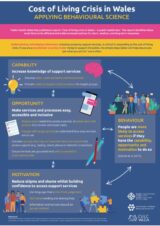
Understanding and shaping behaviours, including accessing support services, is critical in responding to the cost of living crisis. This infographic illustrates how behavioural science can be used, drawing on the report written by Public Health Wales and the resources produced by Hertfordshire County Council’s Behavioural Science Unit.
The International Horizon Scanning and Learning reports were initiated as part of the COVID-19 public health response, to support dynamic response and recovery measures and planning in Wales. In spring 2022, the scope of the reports was expanded to cover priority public health topics, including in the areas of health improvement and promotion, health protection, and health care public health.
In focus: Early childhood education and care
Authors: Abigail Malcolm (née Instone), Leah Wargent+ 5 more
Throughout Wales and the world, health inequality remains a problem that is interconnected with a wider and complex social, economic and environmental dynamic. Subsequently, action to tackle inequality in health needs to take place at a structural level, acknowledging the constraints affecting an individual’s (or community’s) capability and opportunity to enable change. While the ‘social determinants of health’ is an established concept, fully understanding the composition of the health gap is dependent on capturing the relative contributions of a myriad of social, economic and environmental factors within a quantitative analysis. The decomposition analysis sought to explain the differences in the prevalence of these outcomes in groups stratified by their ability to save at least £10 a month, whether they were in material deprivation, and the presence of a limiting long-standing illness, disability of infirmity. The analysis not only quantified the significant health gaps that existed in the years leading up to the COVID-19 pandemic, but it has also shown what determinants of health were most influential. Understanding the factors most closely associated with disparities in health is key in identifying policy levers to reduce health inequalities and improve the health and well-being across populations.
Authors: James Allen, Andrew Cotter-Roberts+ 4 more
, Oliver Darlington, Mariana Dyakova, Rebecca Masters, Luke Munford
The International Horizon Scanning and Learning reports were initiated as part of the COVID-19 public health response, to support dynamic response and recovery measures and planning in Wales. In spring 2022, the scope of the reports was expanded to cover priority public health topics, including in the areas of health improvement and promotion, health protection, and health care public health.
In focus: COVID-proofing the educational environment: 4-18 years
Authors: Mark Bellis, Mariana Dyakova+ 5 more
, Anna Stielke, Abigail Malcolm (née Instone), James Allen, Lauren Couzens (née Ellis), Emily Clark
There are wide inequalities in health and healthcare use between people living in more deprived neighborhoods and those living in less deprived neighborhoods in Wales. Tackling health inequality through a combination of health promotion and early intervention policies targeted toward deprived communities could yield substantial improvement in health and wellbeing, as well as savings for the Welsh NHS.
Authors: Rajendra Kadel, James Allen+ 8 more
, Oliver Darlington, Rebecca Masters, Brendan Collins, Joanna M. Charles, Miqdad Asaria, Mariana Dyakova, Mark Bellis, Richard Cookson
The International Horizon Scanning and Learning reports were initiated as part of the COVID-19 public health response, to support dynamic response and recovery measures and planning in Wales. In spring 2022, the scope of the reports was expanded to cover priority public health topics, including in the areas of health improvement and promotion, health protection, and health care public health. In focus: Cost of living crisis
Authors: Emily Clark, Anna Stielke+ 3 more
, Abigail Malcolm (née Instone), James Allen, Mariana Dyakova