The seventh issue of the Bitesize BeSci e-bulletin features advice, case studies and resources on the ‘appliance of science’ – practical examples and tips to help you implement behavioural science within your own work!
This impact report is for Public Health Wales staff, and stakeholders working across the wider public health system in Wales. It sets out the range of work which the Behavioural Science Unit has undertaken over 2025-2026, focusing on how the Unit is progressing against the areas outlined in the Behavioural Science Enabling Plan for Wales. It acknowledges the partners who have worked with the Unit, provides insight for those that are considering future collaboration, and reflects on the contribution of collective activities towards the routine application of behavioural science for better health and equity.
Authors: Jason Roberts, Jennifer Thomas+ 8 more
, Jonathan West, Ashley Gould, Nicky Knowles, Alice Cline, Melda Lois Griffiths, Paulina Kuczynska, Khudayja Datoo-Jaffer, James Smolinski
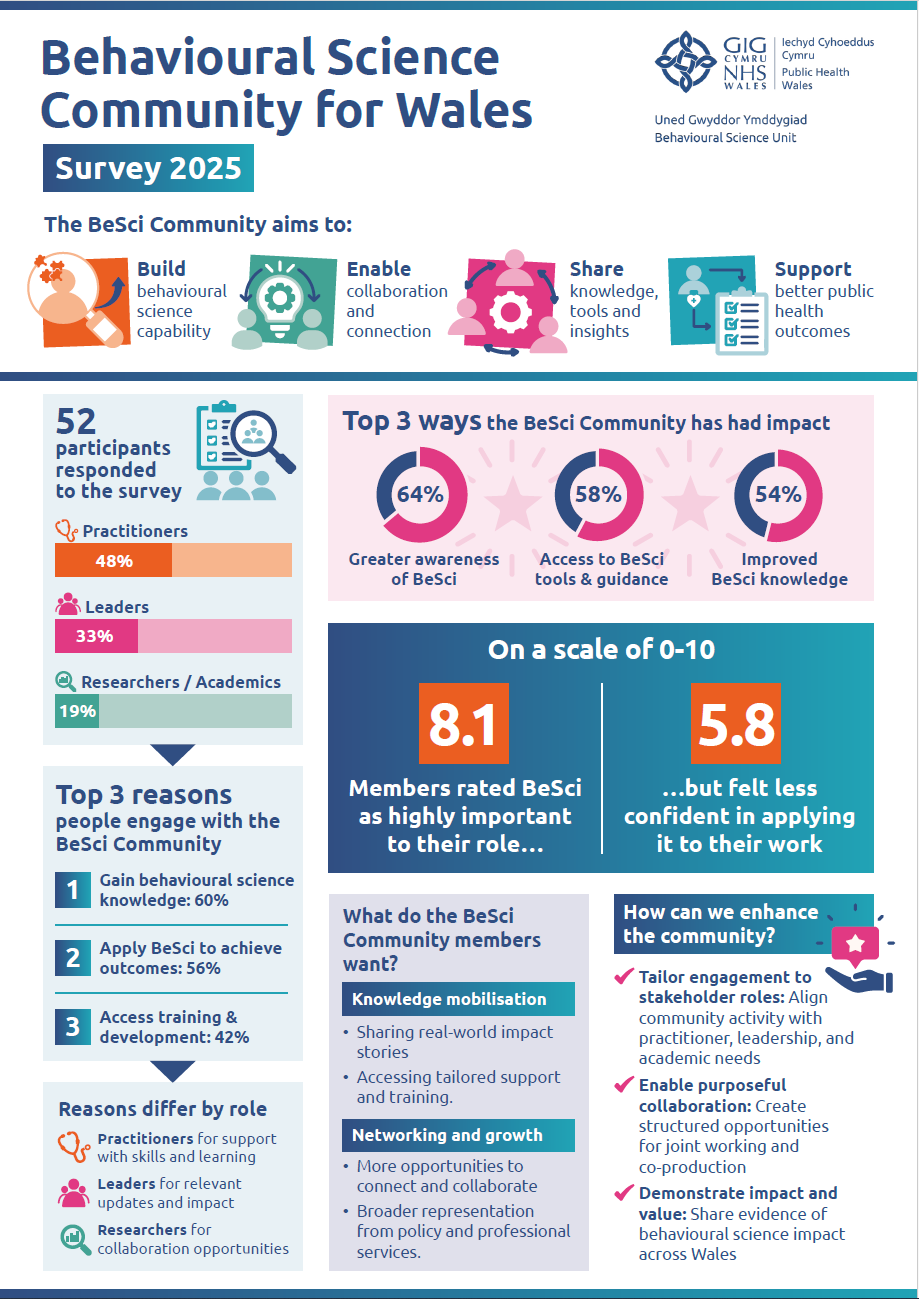
An Infographic summarising findings from the Behavioural Science Community for Wales survey. This includes insights into the types of stakeholders who comprise the Community, reasons for engagement, and how this translates into impact.
The fifth issue of Bitesize BeSci features advice, case studies and resources on building behavioural science capability within teams and organisations.
This report is for the staff, teams and services in Public Health Wales, and the wider public health system in Wales. It sets out the range of work which the BSU has undertaken over the last year, with a spotlight on some of our key activities. It acknowledges the partners who have worked with us, provides insight for those that are considering working with us and, reflects on our impact as well as delivery.
The second issue of the Bitesize BeSci e-bulletin features case studies and resources that look at the benefits of interdisciplinary and collaborative working when applying behaviour change interventions.
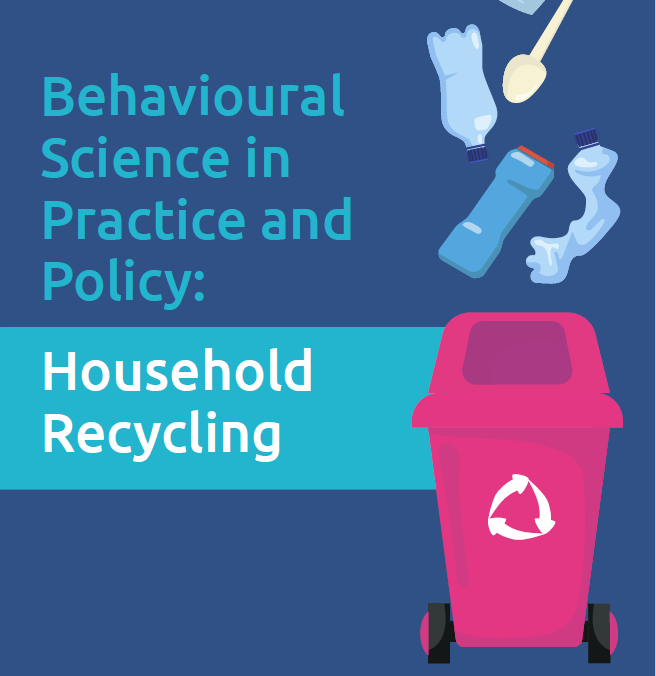
In order to effectively change climate-related behaviours, we must be clear and specific about the behaviour that we’re hoping to change, understand the barrier(s) and/or faciliator(s) to the target behaviour, and implement a broad range of interventions to address and/or enhance the identified barrier(s) and/or facilitator(s). Using household recycling as an example, the purpose of this case study is to show how applying behavioural science can help to identify and implement a range of different intervention types that can help to effectively address behavioural determinants and influence behaviour.
This series includes practical resources to help support you when applying behavioural science to your work. Inside, you’ll find a range of case studies, resources, tools and guides to help put behavioural science theory into practice and optimise the outcomes of your work.
To provide the best experiences, we use technologies like cookies to store and/or access device information. Consenting to these technologies will allow us to process data such as browsing behavior or unique IDs on this site. Not consenting or withdrawing consent, may adversely affect certain features and functions.
Functional Always active
The technical storage or access is strictly necessary for the legitimate purpose of enabling the use of a specific service explicitly requested by the subscriber or user, or for the sole purpose of carrying out the transmission of a communication over an electronic communications network.
Preferences
The technical storage or access is necessary for the legitimate purpose of storing preferences that are not requested by the subscriber or user.
Statistics
The technical storage or access that is used exclusively for statistical purposes.The technical storage or access that is used exclusively for anonymous statistical purposes. Without a subpoena, voluntary compliance on the part of your Internet Service Provider, or additional records from a third party, information stored or retrieved for this purpose alone cannot usually be used to identify you.
Marketing
The technical storage or access is required to create user profiles to send advertising, or to track the user on a website or across several websites for similar marketing purposes.