The Welsh Health Equity Solutions Platform (WHESP) has published a new Spotlight Feature Blog exploring how the Health Impact Assessment (Wales) Regulations is set to transform strategic decision-making and strengthen health equity across Wales.
Authors: Zuwaira Hashim, Lauren Couzens (née Ellis)+ 2 more
This guidance aims to support those working across urban and rural local authorities in Wales to consider, include and promote health and wellbeing through Local Development Plans (LDPs) and the planning system. It provides evidence and guidance about how this can be achieved and why the links between planning and health are so important. The guide can form the basis of an evidence background paper for LDPs or supplementary planning guidance (SPG) and includes five sections.
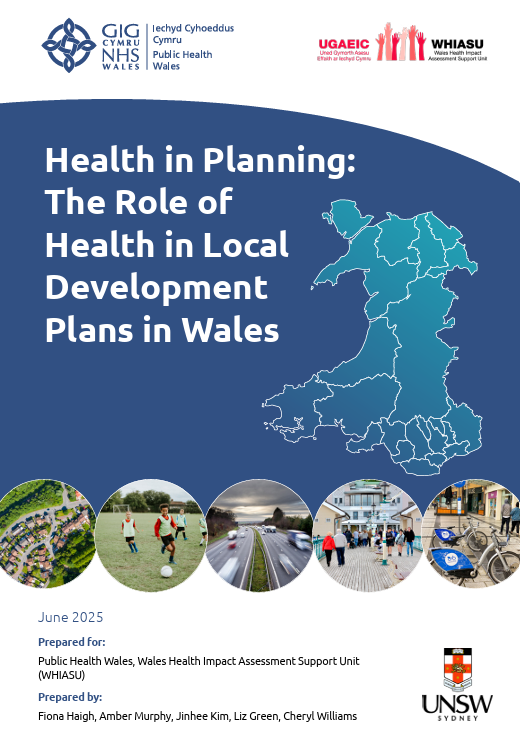
This report presents a summary of the methods and key findings of a review of how health is included in case study Local Development Plans (LDPs) in Wales and the effectiveness of LDPs in supporting the delivery of health and well-being priorities. The report is intended to inform and support the Wales Health Impact Assessment Support Unit.
The planning system in Wales operates at three levels: national, regional, and local. Local Development Plans (LDPs) guide land use and development at the local authority level. This report, commissioned by Public Health Wales, Wales Health Impact Assessment Support Unit (WHIASU), presents a summary review of how health is included in Local Development Plans (LDPs) across Wales. The primary aim of this report is to inform WHIASU’s approach to supporting local governments in integrating health considerations into LDPs. The findings will also add value for other stakeholders working to improve health and wellbeing as it highlights opportunities for strengthening the inclusion of health in local plans. The review of Local Development Plans across Wales revealed several opportunities to strengthen their role in promoting population health and reducing health inequities. Currently, most LDPs address health-related factors indirectly through planning policies such as housing, transportation, and environmental quality. Few plans explicitly define health or health inequalities, and none include specific health indicators or measures. While all LDPs incorporate elements that influence social determinants of health, such as access to services and quality of housing, these connections to health outcomes are often implicit rather than clearly articulated. Our analysis found that LDPs already contain many elements that can support population health and wellbeing. By making these health implications explicit, defining key health concepts clearly, and incorporating measurable health indicators, LDPs could more effectively advance their potential to improve health outcomes and reduce health inequities across Welsh communities.
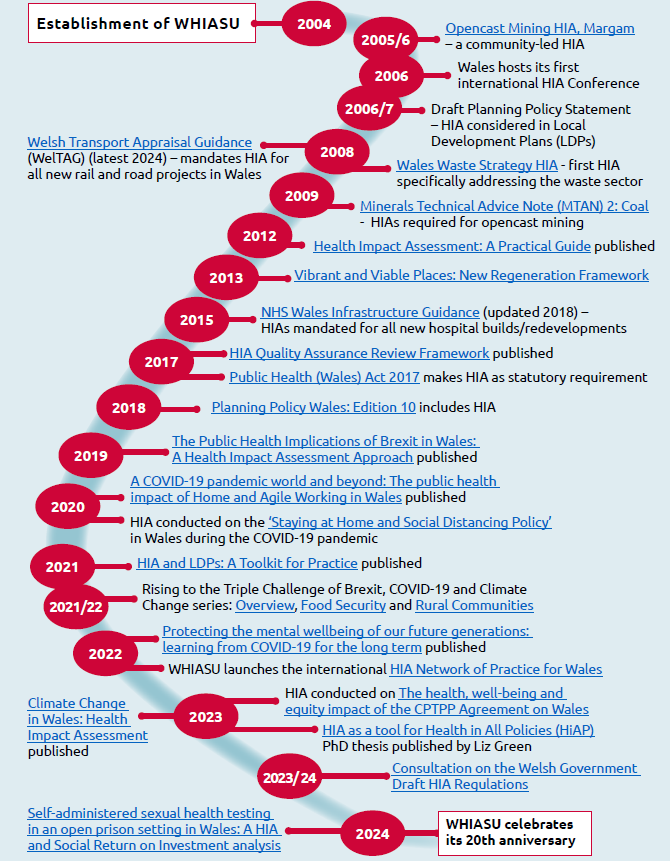
The 20th anniversary of WHIASU marks two decades of advancing HIA as a vital tool for healthier decision-making and reducing health inequalities in Wales. Established in 2004, WHIASU has led the way in enabling the integration of HIA into policy at local, regional and national levels.
The timeline highlights key milestones, documents, and publications in WHIASU’s history and the practice of HIA in Wales. Looking ahead, WHIASU will continue to champion HIA and Health in All Policies (HiAP), supporting public bodies in implementing upcoming HIA regulations under the Public Health Act (Wales) Act 2017.
Authors: Michael Fletcher, Kathryn Ashton+ 7 more
, Laura Evans, Cheryl Williams, Abigail Malcolm (née Instone), Catrin Lyddon, Lee Parry-Williams, Nerys Edmonds, Liz Green
The pandemic has explicitly exposed, and in some examples, exacerbated the health, well-being and inequalities impacts across the population which are derived from determinants such as the environment, land use, transport, economy and housing. This report aims to highlight the major positive and negative health impacts of spatial planning policies during the COVID-19 pandemic on the population of Wales, learn from these, any positive interventions and co-benefits in order to shape a healthier future environment for all.
Authors: Liz Green, Sue Toner+ 7 more
, Laura Evans, Lee Parry-Williams, Tom Johnson, Gemma Christian, Cheryl Williams, Sumina Azam, Mark Bellis
To provide the best experiences, we use technologies like cookies to store and/or access device information. Consenting to these technologies will allow us to process data such as browsing behavior or unique IDs on this site. Not consenting or withdrawing consent, may adversely affect certain features and functions.
Functional
Always active
The technical storage or access is strictly necessary for the legitimate purpose of enabling the use of a specific service explicitly requested by the subscriber or user, or for the sole purpose of carrying out the transmission of a communication over an electronic communications network.
Preferences
The technical storage or access is necessary for the legitimate purpose of storing preferences that are not requested by the subscriber or user.
Statistics
The technical storage or access that is used exclusively for statistical purposes.The technical storage or access that is used exclusively for anonymous statistical purposes. Without a subpoena, voluntary compliance on the part of your Internet Service Provider, or additional records from a third party, information stored or retrieved for this purpose alone cannot usually be used to identify you.
Marketing
The technical storage or access is required to create user profiles to send advertising, or to track the user on a website or across several websites for similar marketing purposes.